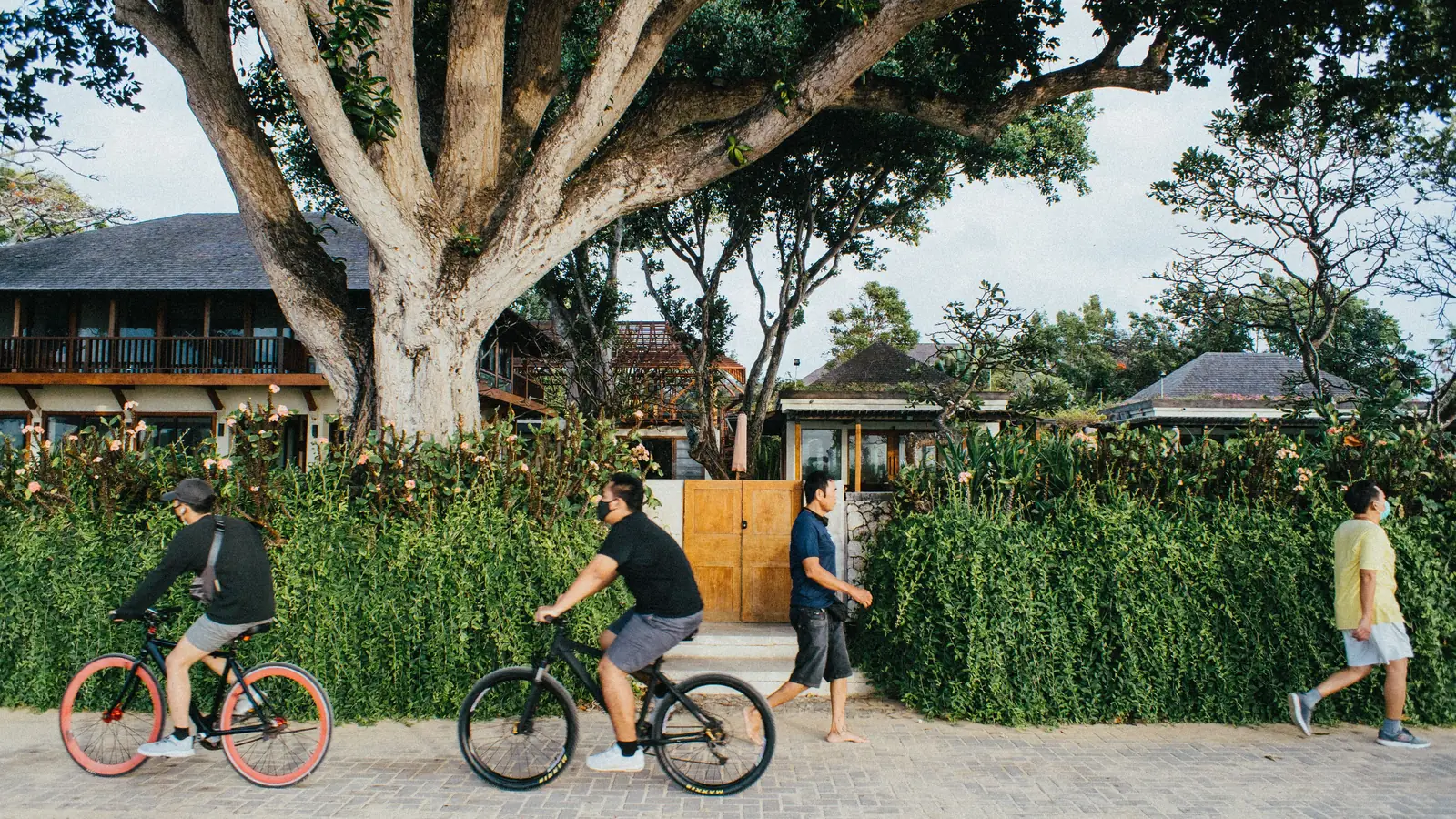
You can enjoy Bali without riding a scooter. The important decision is where you stay—not whether a whole district is called “walkable.” A room close to the cafés, beach or market you will use every day can work well. A beautiful villa five kilometres from those places may force you to book a vehicle every morning and evening.
If you want an easy beach routine, start by comparing addresses near central Sanur's beachfront and Jalan Danau Tamblingan. For shopping and restaurants, examine the Kayu Aya/Laksmana or Basangkasa pockets of Seminyak. For temples, cafés and cultural walks, inspect a central Ubud address. Batu Bolong or Berawa may suit someone who wants to spend most of their time inside one small Canggu pocket—but “Canggu” alone is much too broad to promise an easy walk.
None of these names guarantees safe pavements, a step-free route, a working delivery service or a car that can reach your villa gate. Choose the street and its everyday trips before choosing the photograph of the room.
Which area fits your actual days?
| Where to start looking | A realistic car-free routine | Where the plan can go wrong |
|---|---|---|
| Sanur, close to the beach and Jalan Danau Tamblingan | Walk or cycle along the seaside path; choose nearby places for breakfast, small errands and sunset/evening dining | A hotel described as “Sanur” may sit far inland or across a busy road. The waterfront promenade does not make every residential lane accessible |
| Seminyak, around Kayu Aya/Laksmana, Basangkasa or a carefully chosen beach approach | Restaurants, boutiques and spas near a compact accommodation-and-activity cluster | Road crossings, traffic, scattered facilities and heat can make short-looking journeys uncomfortable; moving between Seminyak and another district still needs a vehicle |
| Central Ubud near Ubud Palace, the market or parts of Monkey Forest Road/Hanoman | Cultural sights, town-centre food, cafés and some daily shopping in one area | Ubud is also a wide region of valleys and outlying villas. Campuhan is a pleasant scenic walk, not proof you can run every errand on foot |
| Canggu near Batu Bolong beach OR Berawa beach | Surf-oriented days, cafés and food within the same selected pocket | Batu Bolong and Berawa are not interchangeable addresses. A rental advertised as “Canggu” can require many awkward road trips even if some businesses are nearby |
| Kuta/Legian around a specific beach-and-shopping cluster | A short resort visit with frequent nearby food, shops and beach time | Congested approaches, late-night noise, crossings and broad district labels require an exact-route test |
| Cliffside Uluwatu/Bingin or remote Ubud/rice-field villas | Beautiful scenery, perhaps a quiet resort stay with meals on site | For a daily car-free life, assume you will need arranged transport unless a real door-to-door inspection proves otherwise; slopes, steps and separated destinations matter |
The evidence behind these distinctions is specific. The Indonesian Ministry of Tourism documents Sanur's seaside pedestrian and cycling route, identifies Seminyak's Laksmana/Basangkasa shopping streets, and places Batu Bolong's cafés near its beach road. Its separate Berawa description confirms that area has its own beach access and accommodation cluster. The Bali Tourism Board describes the Campuhan Ridge walking trail near Ubud. None of these sources measures the sidewalk outside a rental you have not visited.
Three shortlists for three different people
A couple on a one-week beach holiday. You want a morning beach walk, breakfast, dinner and a convenience store without needing a motorcycle. A hotel in the part of Sanur near the coast and your chosen food options makes sense as a first search. Use the official Sanur pedestrian-path description to understand the benefit, then trace the actual hotel entrance to the path, groceries and a dining street. For a day trip elsewhere, plan one booked car journey rather than moving your base every day. If your children or luggage need step-free access, verify crossings and ramps, not only the distance on a map.
A solo remote worker who likes cafés. You are considering “Canggu” because many listings mention workspaces and surf. Compare two specific addresses, one around Jalan Pantai Batu Bolong and one around Jalan Pantai Berawa. Plot your actual workspace, supermarket, gym and accommodation. A room near your chosen café but inconvenient for groceries could still require several booked trips weekly. If you expect to visit Ubud or Sanur every other day, neither pocket solves the cross-island commute: change the base or budget for a driver. The government's Batu Bolong and Berawa descriptions ground the distinct places; the exact walking network must be verified street by street.
A longer-stay resident who prefers culture. A place within an actual walk of Ubud Palace, market and regular shops may let you spend much of the week without riding. But a “peaceful Ubud villa” overlooking a valley can involve steep roads, a bridge, narrow lanes or long stretches without services. Decide whether you want to be near the market every day or enjoy the quiet view and hire transport. A Campuhan Ridge Walk morning is a leisure activity, not a shortcut from every outlying villa to central Ubud.
A pretty map pin is not a walking route
Ask the host for a pin at the actual gate, then draw separate routes to the supermarket, your preferred café/workspace, a pharmacy or clinic, and the nearest practical pickup point. The beach may be 400 metres away in a straight line while the legal crossing or entrance is much farther. A paved lane may abruptly narrow, flood in heavy rain or end at a road with no comfortable pedestrian space. Do not assume every path shown on a map is publicly passable.
At a viewing—or before making an irreversible long-stay payment—test the same route four ways: in normal daylight, at your usual meal/working hour, after dark when safe, and after rain if possible. Check shade, drainage, pavement width, kerbs, crossing speed, lighting and a dry place to wait for a car. If you have a stroller, wheelchair or limited mobility, test every ramp and unavoidable step rather than relying on a hotel's word “accessible.”
There is a useful distinction between a pleasant place to stroll and a practical area to live without a scooter. The promenade in Sanur may serve as a beautiful evening walk; it does not automatically connect your chosen home to a medical appointment. Central Seminyak has shopping streets; that does not prove every crossing is comfortable with children. A Canggu restaurant can be close to your hotel yet still be on the wrong side of a difficult junction.
Will public buses or ride-hailing replace the scooter?
Bali does have public bus initiatives; it is misleading to claim the island has no buses. Badung Regency published a 2025 intergovernmental agreement for Trans Metro Dewata operations and funding in 2026 across the Denpasar–Badung–Gianyar–Tabanan area. That establishes a public-transport programme, not a guarantee that a particular bus serves your villa, runs late or provides the route you need today. Check the current operator's actual stops, first/last useful services and connections before treating a bus as your daily commute.
A licensed taxi, prearranged car or app-based ride may be the realistic fallback for airport transfers, late returns, large supermarket runs and a different district. Availability and pickup permissions can vary by location and operator, particularly at narrow lanes and individual venues. Check whether a four-wheel vehicle can reach the property entrance and whether you can book the return journey. Don't build a daily plan that only works if a cheap ride appears every night.
For boats, long drives and airport pickups, our Bali transport guide covers the separate journey. You do not have to learn to ride a scooter just to make a Bali itinerary possible; you do need to budget for those journeys that cannot be walked.
Compare the rent with the rides you will no longer need
Consider two invented monthly offers, not actual Bali market prices:
| Monthly cost | Villa A: scenic but remote | Room B: near regular errands |
|---|---|---|
| Accommodation and included services | IDR 10,000,000 | IDR 12,000,000 |
| Estimated booked cars and local transport | IDR 3,000,000 | IDR 500,000 |
| Illustrative monthly total | IDR 13,000,000 | IDR 12,500,000 |
In that scenario, the apparently pricier central room saves IDR 500,000 per month and may save hours of riding or waiting. But the result reverses if you rarely go out, your destination is somewhere else or your actual ride quotes are lower. Get two real home quotations and price the trips you will take—not a made-up average taxi fare for all Bali.
Keep your deposit and prepaid rent separate from monthly operating costs, and check landlord and exit terms using the Bali rental guide. Our Bali living-cost guide also separates housing, transport and cash tied up on arrival.
Spend one scouting day before committing to a month
You only need a small comparison sheet, not a spreadsheet of every Balinese district:
| Check on the actual route | Home A | Home B |
|---|---|---|
| Actual gate to breakfast/regular food | ||
| Gate to full grocery shop, not only a tourist café | ||
| Gate to a pharmacy/clinic and reliable car pickup | ||
| Usable crossings, pavement, shade and night lighting | ||
| Rain plan for routine errands | ||
| Coworking/internet or school route if relevant | ||
| Estimated booked rides per week and quoted total cost | ||
| Deposit, all-in rent, cancellation and minimum stay |
If you can, book a short stay in your favourite pocket first, walk the essentials and only then choose a longer rental. If you cannot visit, ask the host for a continuous street-level video from its gate to the main road and insist on a clear map pin. A video is helpful evidence, not independent proof of what the street is like on a wet evening.
My starting recommendation: For a beach-centred trip without a scooter, test coastal Sanur first; for restaurant/shopping days, test a specific central Seminyak street; for town-centre culture, test central Ubud; and for surf and café routines, test one Batu Bolong or Berawa pocket, not generic “Canggu.” Keep the home whose groceries, dinner, safe walking route and occasional booked journey all work together. If those four things don't work from the actual front door, the advertised “walkable” location is not right for your trip.